
by Angela Balas | Jan 18, 2021 | Articles
Online businesses and retailers alike have tried to find ways to attract customers and ultimately lead them to a buying transaction. Online shopping is continuing to trend upwards, as the accessibility of smartphones and devices is greater than ever before. With that said, emerging technologies, like augmented reality ( AR) will make a huge impact on buying decisions and create a massive influence on consumer behavior.
The secret to good marketing is understanding your buyers behavior. In today’s competitive environment, organizations are attempting to discover more innovative ideas in order to support their offerings. Because of more competition on the internet, it is more difficult to capture the customer’s attention. By focusing on appealing the customer through content delivery and engagement– brands can be more successful.
One main aspect of consumer psychology is brand engagement. Consumers that shop online typically have increased commitment to a brand and are more involved in their success and failures. With that said, the more brand engagement someone has, the more incentive they have to buy their products. Per a scientific study done by Bahria University, “ AR impacts consumer brand engagement and purchase intention.” One main reason behind this evidence is that AR allows for insight of a product a brand offers with full reviews, dimensions, and advantages.
Because there are so many different options out there, buyers are often skeptical before purchasing. The majority of consumers hope to receive the greatest information possible before agreeing they are making a smart buying decision. Augmented reality is the perfect solution to the information deficit.
Soon enough, the days of simple photos and video will be over– in comes augmented reality– to give buyers the ultimate product experience. In fact, in an article by SmartTek, they point out that augmented reality influences a person’s pleasure receptors and their willingness to move towards a goal. Thus, AR interaction elicits a positive effect on the buyer leading them to the final goal– a sale.
The article continues to explain the gap between intention and actual purchase. As mentioned, there is skepticism. Especially with retail and clothing, consumers are unsure of sizing and how the piece will look on their bodies. If AR is implemented, the client can virtually try on the product. “Augmented reality marketing virtually puts the product in the prospect’s hands, allowing them to explore it and form their own conclusions on its benefits and quality.”
Overall, leveraging the power of augmented reality will lead to more conversions and better product insight. Consumers won’t have to guess that your product is superb, they will know. Brands that don’t start to switch over to AR technologies will be left behind as others unlock the vast potential of this new technology.
by Angela Balas | Dec 22, 2020 | Articles
With 2021 approaching quickly, it’s time to wrap up the developments that took place this last year and predict what 2021 will bring. These past 12 months proved that emerging technologies, like augmented reality, will indeed become a booming market in the near future. It’s no wonder tech giants, like Apple, are exploring AR wearables and other ways to profit from advanced technologies. In this week’s blog we’re here to provide 5 predictions for AR in 2021.
Marketing and Advertising will continue to take advantage of AR
Lenses like the ones used in Snapchat, have become a means for paid distribution and brand sponsorship. Interactive filters like chips falling from the sky or lipstick try ons are just a few of the types of lenses you’ll see on social media. According to ARtillery’s global forecast report, the current spending of 1.4 billion is projected to grow to just over 8 billion by 2024. As 2021 begins, Facebook, Snapchat, and even Tik Tok will find ways to integrate AR into their platforms to make for an engaging user experience while also feeding advertisers.
AR glasses will become more accepted
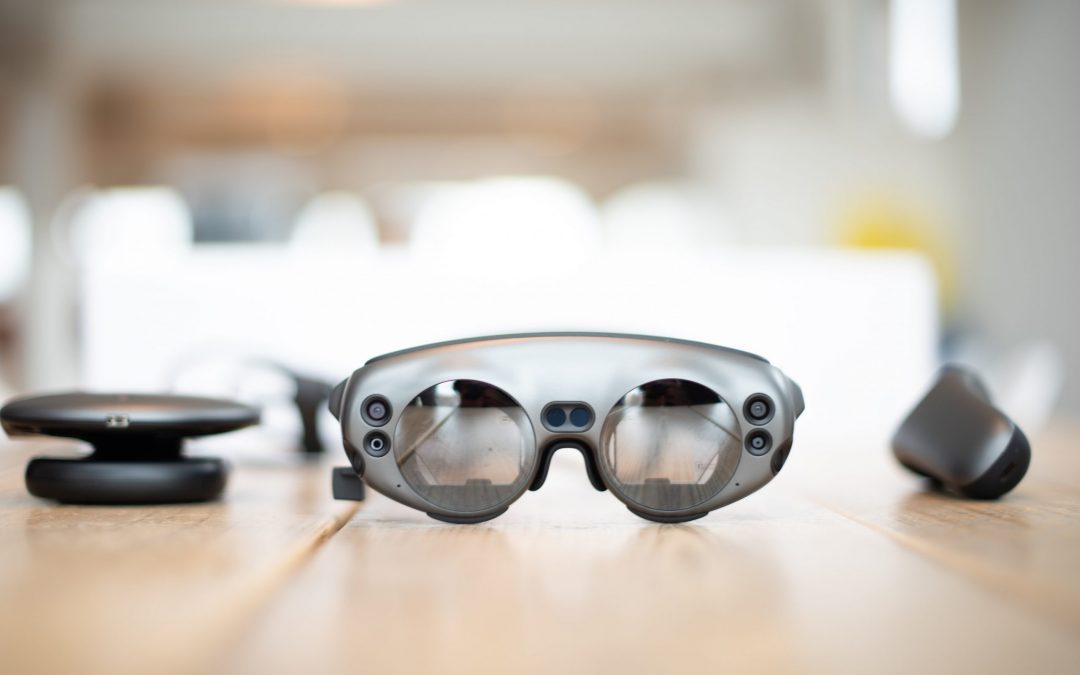
Zuckerberg, Facebook’s CEO, mentioned the company is planning to release its first pair of AR glasses in 2021. Per Venturebeat, “Zuckerberg confirmed that it has been working with fashion eyewear company EssilorLuxottica to create the “smart glasses” product and suggested that it will be cosmetically appealing, arriving under the Ray-Ban brand name.”
With more enterprise adoption of AR– for uses like safety, training, and task completion– AR glasses already had less resistance than years before.
Spatial computing will become a trend in 2021
Spatial computing is known as, “ the digitization of spatial relationships between objects, people, machines, and environments to optimize their interactions. Throw augmented reality into this mix and you have an even better application of spatial computing. There are many use cases for this– specifically for indoor navigation and GPS.
The AR cloud will materialize
Although, there is nothing concrete to exist of the AR cloud, there are developments in place to build an interoperable spatial computing technology. In fact, ARinsider makes note that Google has AR cloud ambitions, which is evident in its interlocking spatial computing efforts. Additionally, MagicLeap released its idea to build AR “layers” over the entire earth. Therefore, we will continue to see the evolution of the cloud in 2021.
Wearables and Auditory AR will make headway
Airpods, Alexa, and audible technologies were on the rise this year. The population seems to feel more comfortable with wearable technology– meaning big companies will want to implement more sensory technology in the next year. Headphones could shift to AR headsets as people become more acclimated to sensory augmentation.
Clearly, we only scratched the surface of how AR may mature in the next year. However, as digital technology trends upwards this year, there is hope that we will continue to be baffled yet elated by the progress made in the AR space.
What are your predictions for AR in 2021?

by Angela Balas | Dec 15, 2020 | Articles
With 2020 coming close to an end, we may take some time to reflect on the year and all that came with it. Although this year threw us for a loop, it helped us realize what is important to us. One of those things being social activities and entertainment. Think about all the significant events that were missed out on this year– from games to music to sports. As social distancing orders continue to take place to prevent the spread of COVID-19, technology improves at a constant rate.
Nonetheless, 2020 has sped up the adoption of digital technologies by several years– and many of these changes could be here to stay. As augmented reality (AR) continues to develop, there are more opportunities for creativity and innovation. Developers of AR can leverage these opportunities to make big changes in the entertainment industry.
AR is transforming storytelling and entertainment and finding unique ways to immerse users. AR and VR will certainly be the next major medium of storytelling. In the future, you could find yourself enjoying one of your favorite music artists from the comfort of your home–or watching a sport’s game like you have front row seats. Immersive technologies allow us to bring the location to people rather than bringing people to the location. The ability to capture events from around the world and share it with whoever chooses is incredible.
One strong use case of AR will be the sports industry. Whether you have nosebleed seats or you’re watching from home, AR allows access to a close-up experience of a game. Per a recent article, predictions were made that watching a live sporting event will become more immersive with ways to access content, view player stats, and see the game. In fact, in 2018, the NBA released an AR app that brought you courtside to the basketball finals. Soon enough, we will see more extraordinary ways that AR will bring sports lovers together– digitally– to enjoy a game.
With music festivals, like Coachella, drawing in attendees from across the country, the event could be even more appealing with the addition of emerging technology. Artists already seem to be creating new spectacular visual experiences each year– but AR could be the next big wow-factor for a live show. AR-generated characters or 3D animations allow for a brilliant performance. Additionally, navigating concerts and music festivals can be confusing, to say the least. If AR wayfinding was implemented, concert-goers would be able to find their way around using their phone and augmented 3D cues.
Clearly, AR has a vast potential for growth in other entertainment niches like gaming, museums, and theater. Most importantly, AR allows for more audience engagement and participation– making it appealing to the entertainment sector. As a matter of fact, according to Statista, “ AR experiences in media and entertainment are most valued by consumers worldwide as of spring 2019”. As technology progresses, we will have the chance to experience the things we love– no matter where we are.
How do you predict AR will disrupt the entertainment industry?

by Angela Balas | Dec 4, 2020 | Articles
As emerging technologies begin to disrupt new industries and make a strong presence in society– we can’t help but wonder how we will interact with these tools. We have seen the rise of ‘tech dependency’ and how major social media platforms are taking advantage of our reliance. We count on our smart devices for a multitude of daily tasks such as finding the answer to a question, checking our bank account, and navigating to a new location. Not only that, but connecting with people from across the globe using social channels like Facebook and LinkedIn can have us trapped online for much longer than we originally planned. With that said, newer technologies like artificial intelligence (AI) and augmented reality (AR) will soon become as significant as smart devices. But, the real question is, will it make us even more dependent on tools to solve our problems? Will we be individually targeted on the internet as we are now?
There is no way to predict precisely what will happen in the future, but technology will undoubtedly continue to grow and advance. Currently, most AR technologies require you to download an app, but there is a possibility to transition to web-based AR– meaning you can scroll through the internet through your desktop or smartphone and interact with the media you see. Certainly, marketing and advertising companies will profit from this ability. Targeted ads and marketing strategies may continue to interrupt your experience– but on a much greater scale.
Answers to questions could be accessed in 3D format more quickly– meaning we may become even more reliant on the internet than ever before. Critical thinking could lessen if technology gives you answers right at your fingertips. In fact, artificial intelligence already allows us to bypass the search process by using voice-interaction to gain accurate solutions to our problems.
On the other hand, augmented reality could be helpful in lessening our dependence on a phone or computer. Because everything would be digitally imposed over your real world, there would be more “hybrid experiences”. Instead of staring at a device for hours on end, you would have the digital layer painted over your physical world.
In an article about the future of AR, Zahler predicts, “The implications are huge. We as a society will move beyond the screen. The user interface won’t be a flat piece of glass, but the physical 3D spaces in which we live and move around. Someday we’ll look back and be amazed there was a time we had our faces buried in our phones, bumping into each other as we walked around.
Arguments against other technology, like AI, are based on the fear that robots will take over our workforce and we will be dependent on them for success. However, machines will never be able to replicate human creativity. Therefore, as long as this is the case, the threat of AI replacing the human labor force is hypothetical.
Overall, we cannot say exactly how emerging technology will affect our dependency on our devices but we can only hope for a system that allows us to function as our very best selves. We can be hopeful that technology will aid in streamlining processes while also giving us the privacy and discretion to interact with it as we choose.
What do you think?
by Angela Balas | Nov 22, 2020 | Articles
Haptics can be defined as technology relating to the sense of touch and motion. As discussed in our previous post, augmented reality is not just about visual information but can encompass so much more. If we are going to create a virtual world in our future, we must have ways to interact with that world using our physical body. It is absolutely possible to integrate all of our senses for a life-changing augmented reality experience.
Touch has a fantastic way of substantiating something and making it feel like it truly exists. With tools like a virtual stylus, humans can touch and interact with an augmented experience. However, as more advanced technology begins to roll out, a stylus is not even needed.
Companies such as Ultaleap are making bold moves towards a future with touch integration. They have created a way to feel and manipulate objects without the need for gloves or a stylus. Using ultrasound speakers, which emit ultrasound waves at high frequencies, they produce enough force for you to feel a tiny dent in your skin. This pressure point creates an impact that touch sensors in your skin can detect– thus creating the sensation of touch in mid-air!
Haptics in AR have strong use cases in aquariums and museums. In fact, Ultraleap has paired with the Aquarium of the Pacific, a non-profit organization, to apply this technology for a fascinating interaction. Per the press release, Ultraleap’s technology, allows users to feel (without touching anything) what is being shown on screen: a wave splash, the blades of a windmill rotating or foam bubbles bursting. This type of experience is highly engaging and rewarding for visitors with visual or hearing disabilities.”
Haptics in augmented reality also has profound implications in the medical field. Specifically, for surgery where accuracy is crucial to the success of the procedure. Haptic perceptions allows surgeon to recognize objects through touch and provide immediate tactile feedback. This feedback can be delivered at the right time, minimizing ambiguity. Surgeons can take advantage of AR head-mounted gear to get access to real-time information for fewer mistakes.
Companies like ImmersiveTouch, combine haptic and AR/VR tools to educate and train surgeons before they perform operations on a patient. Amazingly enough, this technology generates replicas from the patient scans so the surgeons can study exact data to perfect the final process. Other opportunities exist in training, by presenting 3D organs or body parts and tactile feedback as the surgeon “virtually operates” using the system.
Enormous potential exists for the field of haptics and augmented reality. As humans, our senses of touch, vision, and hearing combine to make our world more engaging. We must think about how technology can replicate the unique human experience and provide more opportunities for growth and advancement–using our senses.
Where do you think haptics have opportunities for growth in AR?
