by Angela Balas | Oct 9, 2020 | Articles
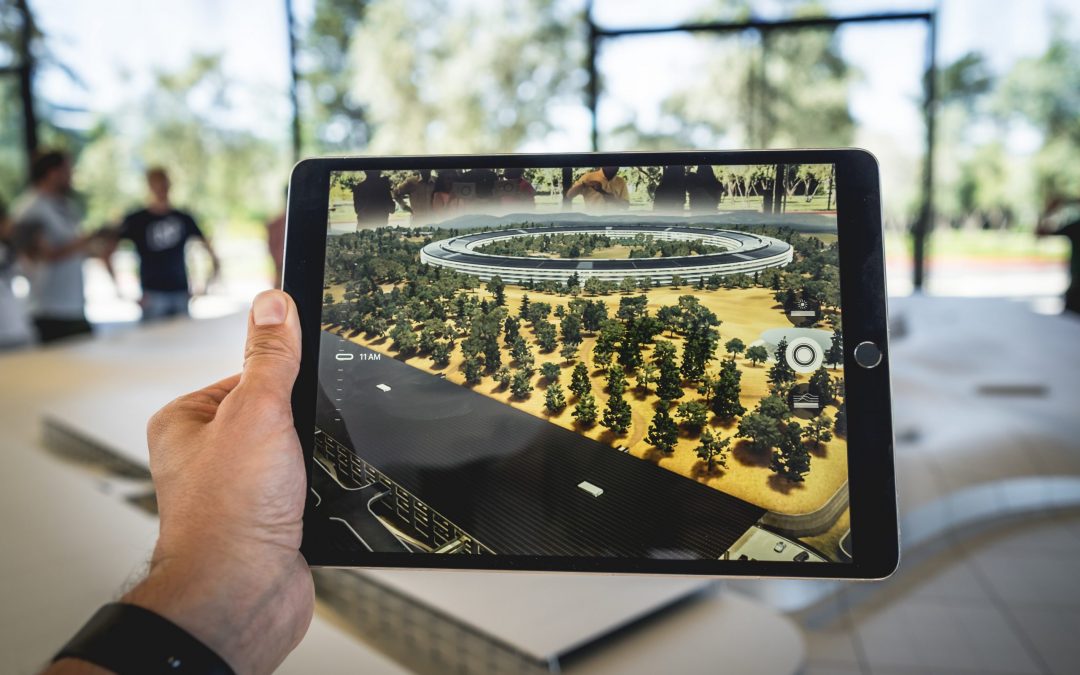
With support from big names like Google, Apple, and Facebook– 2020 is just beginning to showcase the power of Augmented Reality (AR) in our future. In fact, Statista predicts that in 2023, 35 billion dollars will be spent on these technologies by the manufacturing and construction industry alone.
Therefore, we felt inspired to gather 10 meaningful updates in AR– which may ignite your own innovations.
1. Investments pour into the AR space
According to recent statistics from Techjury, the AR market value rose from 1.8 billion in 2018 to 3.5 billion in 2019. After Apple released ARkit, ARkit only apps had 13 million downloads. Additionally, over 50,000 units of the HoloLens have been sold. Clearly, AR is projected to surpass VR revenues and companies are beginning to understand the significance of AR.
2. AR for navigation solutions
The GPS system is heavily relied upon to navigate the outdoors, but AR will be the solution to indoor navigation. Airports around the world are beginning to deploy AR solutions for passengers to find their way around. Gatwick airport, London’s second busiest airport, has created an augmented reality wayfinding app. They have installed 2000 wayfinding beacons to enable augmented reality wayfinding and routes to terminals and gates. Per VR focus, the app won the Mobile Innovation of the Year award at the National Technology Awards. Other industries including retail, travel, and real estate will follow in their footsteps– as AR-powered navigation is expected to move into new territory.
3.AR and AI will combine to create immersive 3D experiences
Artificial intelligence and machine learning are booming sectors in technology. In the spatial computing world, voice and immersive media can work together to personalize experiences. MobDev points out, “35% of sales on Amazon are derived from its recommendation engine, which leans heavily on data science and machine learning to deliver search results and match advertisers with customers. Combining AR and AI will be extremely useful as a marketing tool that can help companies learn about shopping preferences.
4. Home improvement and Furniture stores adopt AR applications
Ikea was one of the first to establish an Augmented reality app that helps you digitally position your furniture in your house to identify if it’s the right fit– without ever having to visit the store. Wayfair and Lowes also created similar apps using AR technology. It is clear that furniture retailers can easily take advantage of AR to improve customer satisfaction.
5. AR begins to disrupt healthcare
There are some educational applications for Augmented Reality in healthcare– like training medical staff or new students. Additionally, Augmented Reality can help medical staff with tasks that require precision. Technologies like AccuVein are being created to assist medical professionals with patient care. AccuVein uses projection-based AR to cast a virtual real-time image of underlying vasculature on the surface of one’s skin.
6. AR is shifting to Industrial Use
Immersive technology can be leveraged for the manufacturing industry– increasing safety and efficiency. According to Forbes, “The 2020 XR Industry Insight report collated by VR Intelligence states that 65% of the AR companies surveyed said they are working on industrial applications, while just 37% working on consumer products and software.”
7. 5G will power emerging Technologies
The higher throughput of 5G will support AR and VR content that’s streamed from the cloud. 5G was introduced in early 2019 and with its extremely high speeds, it helps solve the high bandwidth demands of AR.
8. Automotive
People have been dreaming of self-driving cars for centuries– and here they (almost) are. The automotive industry is now investing millions of dollars into AI and AR-powered systems to recreate the driving experience. Panasonic recently revealed an AR demo car that can project large images in distances up to 10m. The car augments images on the driver’s windshield so they can continue to maintain focus on the road.
9. Coronavirus accelerates the use of AR and AI to maintain social distancing
Unfortunately, the pandemic was unpredictable, but we saw a huge spike in workplace technologies like zoom. As weeks turn into months, companies must adapt to continue to promote collaboration and training. Cities such as Seattle and Boston have already piloted using different forms of AR/ VR to help city planners, elected officials, and citizens better participate in city planning.
10. AR for fun!
From museums to video games – AR has vast potential to add some excitement and spark to average experiences. For example, Google Lens recently introduced new features to make at-home learning more fun for families. For children who are looking to learn and tap into their imagination– AR creates a new world of possibilities.
What do you think are things happening in the AR that are making a difference in the update and use of the technology?

by Angela Balas | Oct 2, 2020 | Articles
Immersive technology blurs the line between the digital and physical worlds. It allows for a user to access the complete 360-degree space around them. We are at the forefront of technology adoption at the enterprise level, with the power and utility industries beginning to see the benefits of implementation. We have explored how augmented reality will assist with safety and efficiency in the utility industry– as baby boomers retire and more training is required. However, today we will dive deeper into more use cases for immersive technology in the energy and utility sectors.
Work Order Management
Work order management, “ a set of procedures that are designed to process a work order in a timely and efficient manner”, are an integral part of a field technician’s daily routine. By merging immersive technology into the work order management system, the process can be streamlined. Immersive technologies, like Augmented Reality, can guide employees through their work orders in real-time, while they are using a tool or their attention is elsewhere. This process can guide technicians through a step-by-step checklist and even send the information out to managers.
Inventory Management
Naveen Joshi, a columnist for Forbes, brings up inventory management as another strong use case for mixed reality in the energy sector. “AR technologies can be used to superimpose digital information on the real world through a smartphone or a tablet. This information is beneficial in situations such as power outages or damage to equipment. The technicians can capture images of damaged equipment using augmented reality.” AR can help the technician figure out what parts need to be repaired and request the right personnel for the issue. Therefore, increasing operational efficiency and improving the overall maintenance process.
Asset Mapping
Engineers can see digital overlay above their assets that is followed with instructions and a mapping of asset functionality. Joshi puts it into perspective, “Augmented reality technology can be used to generate 3D models using 2D diagrams of components. 3D models help technicians get a better understanding of the equipment than 2D drawings. The 3D models can also be used to view the internal components of a piece of equipment and explore its inner workings.” Emerging technology, like wayfinding and GIS, can combine with AR and VR to locate and maintain assets. With this simplified and user-friendly approach, crew members can use their time more wisely at work while maintaining success.
Immersive technologies have the ability to be a growth driver in the digital transformation journey for the energy and utilities sector. Workflows will be converted from manual processes to automated and interactive. We will see how it will be beneficial in a variety of ways and help companies run more effectively. What are your predictions?

by Angela Balas | Sep 25, 2020 | Articles
Do you remember times before the World Wide Web? With technology being a central part of our daily lives– it feels like a fuzzy memory to recall a world without it. The Web made it possible for people to share information and connect from thousands of miles apart. It is easy to take it for granted now, as everything we need is right at our fingertips.
What if I told you that we may have another revolutionary period coming our way. That is one of emerging technologies such as Augmented Reality (AR) and Virtual Reality (VR).
You may think integrating such new technology is out of the question, at least in the near future.
However, let’s dive into the story of the World Wide Web a little more.
The World Wide Web marks the end of an era of frustrating incompatibilities between computer systems. According to Tim Berners Lee, it is defined as “ The universe of global network-accessible information”. The Web, put simply, is a shared information space where people can collaborate and communicate.
Today, we are certain it has made our lives easier. I personally cannot imagine doing research before the Web. I could list an endless list of other tasks that are accelerated because of this information system. Yet, back then, people still doubted the power of the World Wide Web. In fact, Tim Berners Lee, the inventor of the web, was first rejected when he presented his idea. There was also a great deal of resistance, as skeptics were worried about the adverse effects on the economy and society as a whole.
In his article, Sergey Galyonkin, recalls trying to raise venture capital for the world’s first internet advertising company in 1995, and couldn’t find a single investor. Nobody believed it would take off, but in a matter of five years, that quickly changed.
If we had a looking glass into the future we would see that emerging technologies will become an integral part of our lives– much like the Internet and Web are today. AR and VR will follow a similar trajectory to that of the World Wide Web.
There are definitely skeptics in this space too, with distress over a plausible “hyper-reality” if we merge AR with our current world. Although it is important to take these potential issues into account, we will certainly develop ethics around interactive technology as we move forward.
Emerging tech will transform industries across the globe. In particular, our education system, which has not radically changed in decades. Children thrive in an environment where they can tap into their creativity– and technology has the ability to customize experiences for each individual student and their learning needs. As computers and iPhones are strictly virtual, augmented reality combines both real and virtual content. Learning could be much more engaging if a student could put on a set of glasses and interact with a multi-dimensional image of the inside of a cell or a chemical element.
Galyonkin reiterates that “Virtual Reality holds the promise to be even more transformative than the flat Web was — reaching into every segment of every market and remaking it to be virtually accessible”. He mentions virtual reality touching industries like real estate, eCommerce, and entertainment.
Can we draw similarities to the rise of the World Wide Web and emerging technology? I like to think so. There will always be resistance to change and the unknown, but in the end, we will see how humans and technology can thrive together to create an exciting and transformative future.

by Angela Balas | Sep 18, 2020 | Articles
Imagine a museum experience where you can learn and discover new things from a completely different lens. Exhibitions and art installations can be brought to life in unique and exciting ways, while complex art pieces can be better understood– all with the use of augmented reality (AR).
We are not far off from getting to experience this ourselves today. Museums are beginning to take major steps towards using augmented reality for better and immersive learning and exploration.
Interactive technology, such as augmented reality, will take museums to the next level. Per an article by Kadenze, “By adapting technology like augmented reality and interactive exhibitions, museums have reached a new era of education and accessibility.”
The adoption of AR can also enable museums to leverage the technology to attract more visitors and give their patrons a whole new level of experience. The experience of walking up to an exhibit and potentially feeling disconnected or confused is rapidly changing thanks to advanced immersive technology.
According to Kadenze, current museums, such as the San Francisco Museum of Art, are employing AR, “These playful extensions make art history accessible to a new generation of tech-savvy millennials and children alike.” The often daunting subjects of history and science can be presented in a creative and user-friendly way. Augmented reality has the potential to facilitate educational experiences in museums around the world and bring history and art to life.
Augmented reality has the power to effectively tell stories. Oftentimes, artwork has an elaborate and intriguing message just waiting to be told. Digital overlay can convey an artist’s message or motivations while captivating the individual. Emerging technology can also re-create history or tell a story from across the world.
According to Kadenze, Google Arts and Culture has paved the way for making virtual museum tours available by partnering with major cultural institutions such as the Musée d’Orsay in Paris. “The opportunity to step into art museums around the world lets anyone discover the nuanced ways each culture interprets historical and contemporary art anywhere.” It is thrilling to know that immersive technology can create connections across the globe that weren’t possible before.
Museums of the 21st century will be engaging, exciting, and powerful. Kadenze makes a strong point that the museum experience no longer has to be a solitary moment, and instead can open opportunities for unexpected interactions that stay with visitors outside of museum walls. Future generations will have the pleasure of experiencing museums like never before. Technology has the potential to disrupt existing systems for the better while creating more opportunities for learning and imagination.
How do you think immersive technology will benefit museums in the future?
by Angela Balas | Aug 5, 2020 | Articles
The Digital Native– a term first coined by Mark Prensky in 2001– to describe the generation of people who have grown up in the digital age. Well, me being a 22-year-old college graduate, I fit into this description perfectly. I decided to do a short series where I am going to explore the monumental rise of technology from my perspective– and other “digital natives” who I work alongside with.
Yes, it’s true, I don’t quite remember a time without computers. However, I remember the hassle of dial-up internet and extremely slow speeds. My parent’s home office computer was the size of a dinosaur– I may be exaggerating a bit– but you get the point. Using the internet was not even worth it at times. As 6th grade came around, I was uber jealous of my friends who were allowed a cell phone– with the most basic calling and texting functionalities. I, on the other hand, still had to call my friend’s home phones and politely go through the parent who picked up on the other side.
Then came the rise of Apple. I distinctly recall being able to switch from my hand-held CD player to an iPod shuffle, and I was ecstatic. The idea of having my music all in one place was amazing. One of my top requests on my birthday that year was an iTunes gift card. As each song costs $1.29, I was very wise about my selections. In 2009, Apple released the newest version of the iPod Nano, with the biggest screen yet. Obviously, this was the start of Apple’s big takeoff. Eventually, I got hold of the iPod touch and a phone of my own. I shared my phone plan with the rest of my family, so I had a limited number of texts I could send before we were charged extra. My iPod touch made it easier for me to text my friends on wifi– with no extra charge, I felt like I had the world at my fingertips.
It is fascinating to look back at my childhood and grasp the way technology changed so quickly. Many people may look back and wish they had invested in Apple or any of the other “Tech Giants” at the time of their rise. Needless to say, it seems like we are at another turning point for breakthrough technologies. Ten years ago, if you would have mentioned artificial intelligence to anyone in the room, they would have thought you were referencing a sci-fi movie. However, today, Alexa has already proven the power of artificial intelligence. Mixed realities– such as AR and VR– are likely to be just as significant as the rise of computers.
As businesses, colleges, and healthcare systems all begin to embrace immersive technology, my life and future career has the potential to look much different than generations before me. It is both daunting and exciting. Yet–as a digital native– it can’t be too anomalous, can it?
