by Bob LaBelle | Jul 22, 2020 | Articles
It is interesting to look at the impact of global and local crisis on technology progression and adoption. Right now we see how the pandemic is accelerating technology transformation. We see it in our daily lives—individuals and enterprises alike—as we rely on a collection of technologies and platforms to stay connected, perform our jobs, continue education and more. There has been a huge pivot to remote working, learning, healthcare, banking, etc. We were already on the digital transformation journey, but out of necessity (not to mention to stay competitive, relevant, connected and engaged) people are even more so becoming increasingly reliant on websites and applications for critical services, entertainment, work, and learning. This will have a long-term impact on how we use technology and what new or emerging technologies—AI, edge computing and AR—will be boosted and put into the field more quickly.
Immersive technologies like AR—which enhance our physical world—could be used to enhance virtual learning and training, enhance virtual conferences and events and increase consumer confidence in online purchasing decisions that are not only needed in our current world situation, but beyond as accepted and an expected part of our daily technology stack. As we look for alternative ways to work, learn and play, there is tremendous opportunity for AR to provide an immersive experience we choose vs what we need.
In doing some desktop research on how crisis catalyzes technology use and in the context of the current pandemic, I learned that (no surprise) video conferencing provider growth exploded. Zoom for instance became a household name and by April had 300 million users a day—up from 10 million before the pandemic. And Instacart for grocery delivery saw sales of $700 million per week—up 450% since December 2019. In the AR space, Mojo Vision—a startup that is working to bring AR contact lenses to the world, did a study in June that noted that 95% of respondents reported their attitudes toward technology became more positive as a result of the pandemic. And 42% of consumers in the early majority group—who typically wait for a tech product to become popular—indicated that the pandemic sped up their adoption of technology and 48% said they were likely or somewhat likely to continue to buy or try new devices and technologies sooner rather than later.
AR and immersive technologies aren’t necessarily new or futuristic. They are fully developed technologies that are reliable and impactful. A challenge to their widespread adoption was exposure, familiarity and an impetus—which we now have. Time will tell if the interest, uptake and demand will last and expedite AR’s use and deployment. Maybe we all have an early-adopter within us that is willing to take the leap to learning about and using different or new technologies—that collectively will drive a transformation of technology in our daily lives. But I tend to think that post the pandemic and measures being taken to prevent spread, the behavior change it fueled will last.
What do you think?
Rob LaBelle
by Bob LaBelle | Mar 23, 2020 | News
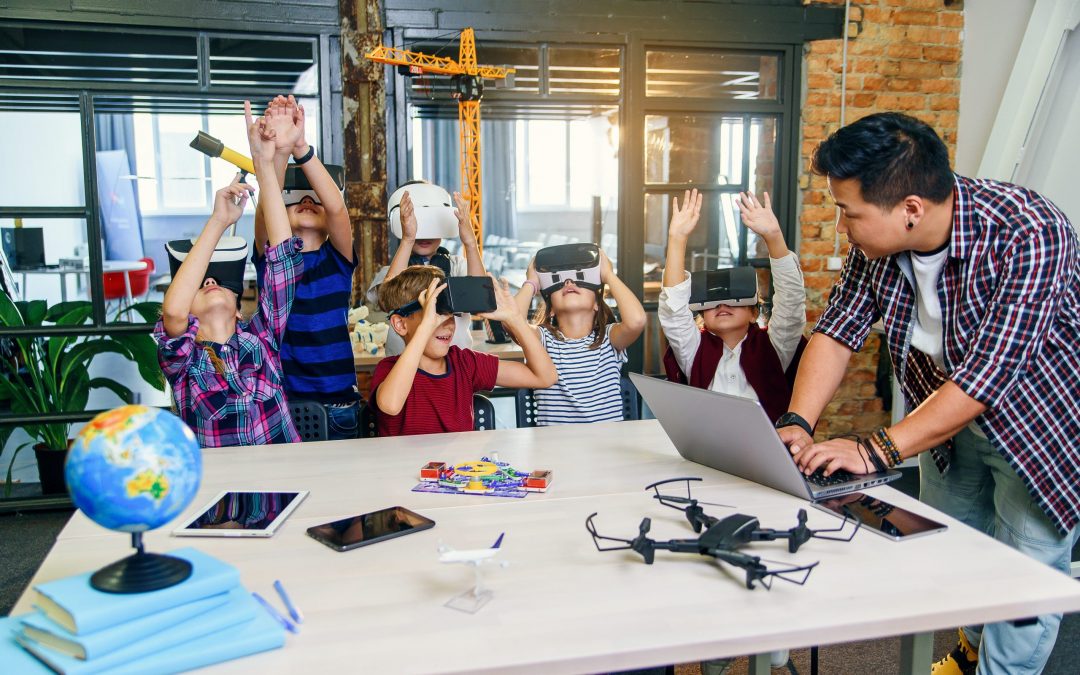
Today we are increasingly seeing the potential of Augmented Reality (AR) in various sectors and industries. The technology is advancing, along with AR enabled devices. Many manufacturers of mobile devices such as tablets and smartphones are using AR solutions to increase the value proposition of these devices and enhance the user experience. This coupled with AR software development kits for easier development and creation of AR apps and experiences and growing commercial use of AR is triggering fresh and innovative ideas on how to use AR, including in learning.
Technology has revolutionized teaching and learning—whereby lectures, seminars and classes no longer have to be in a confined physical space. E-learning has been around for sometime, with businesses adopting e-learning in the early 2000’s and with the explosion of social media and online learning around 2010. But we could say that e-learning, virtual learning or distance learning experiences have been a two-dimensional or flat experience. Now imagine the use of AR that provides an immersive and three-dimensional experience that can inspire creativity and spark imagination. In short, AR offers tremendous possibilities to redefine e-learning.
AR coupled with e-learning can greatly increase learner engagement by letting learners participate actively and authentically with the learning content, versus being a passive recipient of information. Imagine—through the use of AR—geometry students being able to check out 3D geometric forms from multiple perspectives and where they can rotate the shapes and view them from the inside. Imagine a technology that can help to teach challenging concepts in biology or math and to innovatively teach about different cultures and places in the world. AR can help learners enhance and manage their own learning, throughout the active interactions with the real and digital environments. Students can easily manage their own learning and change objects which are not real in an augmented environment in order to obtain and acquire understanding and knowledge.
Traditional methods of education as we know it are becoming a thing of the past. They are becoming increasingly digitized, and being driven by technology innovations. In fact, EdTech, the education technology industry, per a study by EdTechXGloba, is expected to reach $252 billion by this year. And a significant trend is the use of AR, with more than 1 billion users expected to join the trend in 2020 —opening opportunities for educational institutions and businesses.
And top eLearning stats from the eLearning Industry reinforce the opportunity for eLearning providers and platforms in the Global eLearning Market, which they estimate to reach $325 Billion by 2025. Other notable stats include:
· 65% Of US Faculty Support Open Educational Resources
· 43% Of US College Students Find Digital Learning Technologies “Extremely Helpful”
· 67% Of Organizations Offer Mobile Learning
If you are working in EdTech or a user of e-Learning platforms and tools using AR, we invite you to share your experiences, insights and predictions for AR in learning.

by Bob LaBelle | Mar 16, 2020 | News
Think about how many times you have bought something you had to assemble—furniture, a BBQ grill and kids’ toys—and the frustration of using the provided printed instructions. Think about the times you decided to go the DIY route to fix your dryer, build that shed, install your own thermostat, do some landscaping, etc., and needed real-time help. After some time spent with written instructions and users manuals—and even maybe a phone call to an 800 number, we fire up our laptops and more often use our mobile devices as we turn to online videos for help. A bit better than the written instructions, but not fully or always helpful.
According to a TechSee survey about self-installation, complexity is a real barrier to DIY-ers. 31% of consumers reported having to give up mid-process and contact a customer service agent for assistance after failing to self-install successfully. Baby Boomers are even more challenged by self-installation, with a telling 87% reporting that they did not find the process easy.
Enter Augmented Reality (AR)—the ability to present the real-world, overlayed with digital information. While some people think of AR as a technology for games and enhanced shopping experiences, its practical applications go well beyond these, and a variety of companies are using AR to enhance their customers’ experiences (CX) along the full customer journey—including to how to put something together or install a product. Assembly with AR is an application that can use a virtual 3D model (a mathematical representation of something three dimensional) and combines it with AR for use in a real live environment using smartphones to help many of us who are challenged with the provided assembly instructions.
By turning to an AR assembly or instructions solution—an AR guide can provide superimposed instructions on mobile phones. This video representation of the physical product (in 3D) can be shown with step-by-step assembly instructions and helpful tips. It can overlay the product—or pieces of the product—with animation that simulates and clarifies the self-assembly process.
AR provides an effective digital interface that displays the content visually during initial setup, configuration, troubleshooting, regular maintenance or for demonstration of proper usage. It delivers an immersive experience, enabling the user to feel self-reliant, empowered and in control, translating directly into a positive CX.
AR is poised to serve as a key technology to improve consumer-product engagement, and forward-thinking companies that are looking to go to the next level of customer service and engagement and customer loyalty are exploring and starting to use AR to enhance their full CX. If you are using AR for your CX, we invite you to share your story.
by Bob LaBelle | Feb 23, 2020 | Uncategorized
For the most part, as soon as technology moved from something that you used at work into something that became a part of your everyday life, it became something retailers put on their radar. Personal computers, the internet, mobile phones, social media – most of the 21st century of retail has been defined by consumer adoption of technology. The next technology already hitting retailers’ radar—both brick and mortar and online—is Augmented Reality (AR).
A drawback to online shopping is that many of the sensory elements that customers use to make their purchasing decisions are not there. When shopping online, a customer cannot touch or feel an item, see how it works or know how it will fit in their home. The loss of this interactivity and presence in the shopping experience leads to uncertain buyers and more abandoned carts. With shopping online in particular there is a lot of consumer guesswork, which can lead to unsatisfied customers and company loss through increased return rates. According to research conducted by the National Retail Federation, merchandise returns in the U.S. represent nearly $16 billion of the retail market.
Enter AR. It is sure to be a true difference maker. Retail has always been about engaging experiences with the right delivery—time and place. The evolution of e-commerce shows past milestones that have addressed these same worries with enough efficiency to make online shopping a consistent revenue channel for brands and stores. Still, as the digital era matures in how personalized it has become, consumers are expecting more of these experiences. To continue this engaging experience in a way that provides value to both sides, AR is helping shoppers visualize products in the environment around them, in real-time.
AR is becoming a viable option to transform the customer experience through AR-commerce—connecting augmented experiences with direct product interactions and seamless purchase opportunities. But some may ask—how fast? According to an Adtaxi survey, about 10% of US internet users have used an AR app or feature that lets them virtually try on apparel or view furniture in their homes. But 45.0% would be interested in trying out the technology. And in the same study 30% said they thought they would never visit a clothing store again if the technology could help them shop clothing fit with confidence. And there are increasing tech development and tools that enable the creation of AR retail content.
As the technology becomes more sophisticated, AR-commerce is set to expand the experiential retail market in impactful ways by:
Creating an Engaging Buying Experience
While shopping online, a customer has to imagine and interpret what an item would feel like in their hands, or look like in their home. AR technology helps overcome this online buyer’s challenge by transforming an imagination into a reality. A customer who can accurately see how any product will actually feel in their environment, at-scale, will be able to purchase with more certainty and satisfaction.
Customizing Selections
Before making a purchasing decision, customers often want to see various color selections and explore other modifications that might be available. AR makes it easy for consumers to explore their options and make personalized modifications while online shopping. With retailers who offer augmented reality, shoppers can change the color of furniture they’re looking to buy to see how it looks in their home first.
Understanding Products and Features
Online shoppers, as well as in-store customers wish that they could interact with a product to get a feel of how it works before buying it. AR allows shoppers to trigger animations to show how complex products like appliances or electronics work and function.
There is tremendous potential for AR in retail and online commerce. AR-commerce provides a new medium and interactive story to inspire purchases and brand loyalty. What will be your AR retail story?
by Bob LaBelle | Feb 12, 2020 | Uncategorized
XR—extended reality—is essentially an umbrella term given to computer-generated environments that either merge the physical and virtual worlds or create an immersive experience for users. It represents the convergence of AR, VR and MR in which the best elements of each aspect are utilized and optimized. While they have their distinct differences, all XR technologies blend the real world with a virtual world to create an immersive experience for the user.
XR has immense potential to transform the way we experience our world today. The XR market includes significant contributions to create transformative products and applications borrowing from the existing worlds of gaming, movies, live events, healthcare and marketing and advertising—all which fall under the immersive industry domain.
Research by Visual Capitalist projects that the XR market will be worth $209 billion by 2022, and 63% of shareholders in XR technology companies believe the technology will be mainstream by 2024.
But how can this technology benefit your business? Here are a few ways . . .
Brings Customer Experience to a New Level
With XR, customers can visualize products and interact with them to get a practical and emotional feel for what it would be like to have them. It engages people on a deeper level—more than a 2D image or even a 3D model can—allowing brands to connect with customers to establish trust and brand loyalty.
Enhances Communications and Collaboration
Imagine development teams being able to collaborate on projects—when they are miles away from each other. Immersive tools that function in real-time, gives teams the ability to work together on complex visual data sets. This level of interconnectivity streamlines communications and improves efficiency to projects.
Drives Productivity
XR technology can pave the path for greater efficiency in companies—leading to increased productivity. As XR can be visual—bringing data and information to a physical space or situation—it makes information easier for users to absorb in real time. It allows immersive, 3D experience that facilitate on-the-spot solutions.
Boosts Training
XR technology is an impactful training tool. With immersive XR experience people can train in dangerous or critical scenarios without risk. Today, this technology is already in use in many sectors, including the military and critical infrastructure environments.
Advances Data Visualization
Today, we live in a data-driven age. And businesses that embrace data are those that will thrive. But it can be overwhelming and challenging to bring visual context to hard figures through charts and graphs. Imagine being able to use data in real time in a live environment with a visual “walk-through” of that environment by wearing AR glasses. The data you once saw on paper is transformed into the actual environment or situation you are testing or monitoring.
With XR incorporated into your business, you can create a culture of transformation—using immersive technologies in your training, design and development, testing and marketing programs and processes. And you will be able to connect with your customers in new and impactful ways. I leave you with one last thought. Today, people just do not want or purchase products. They purchase and want experiences.
